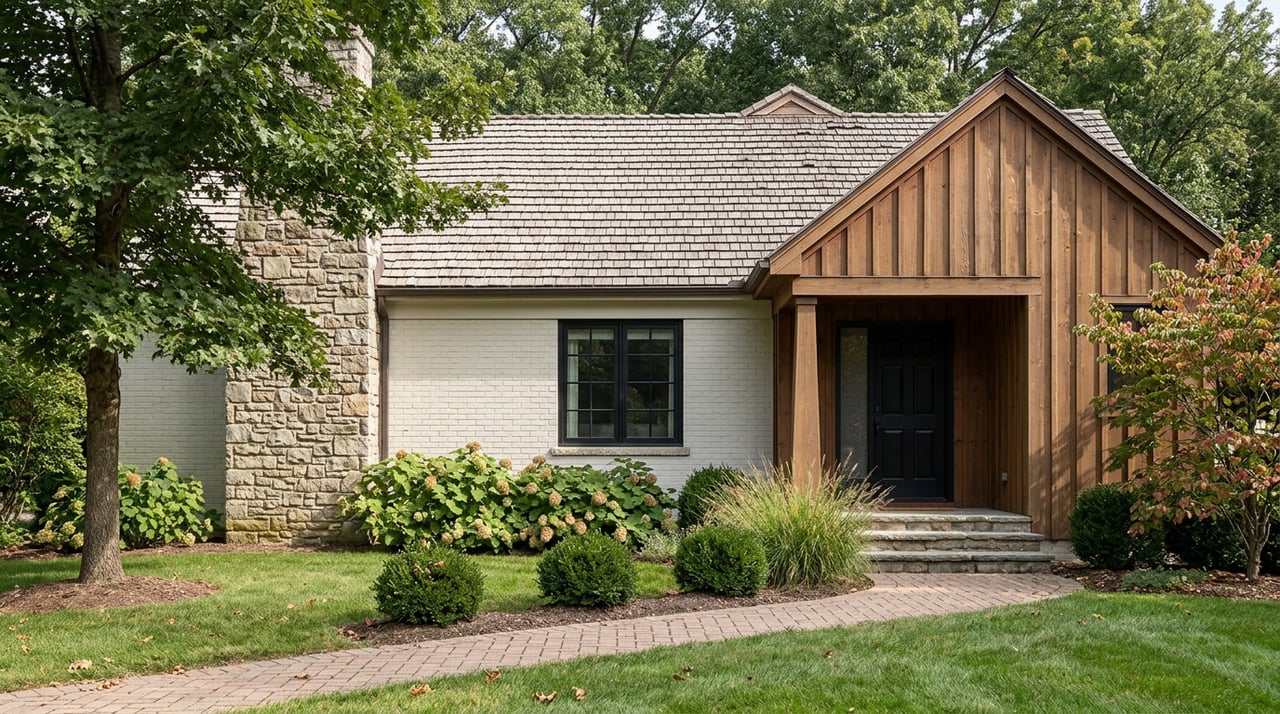
Buyers who fall for a home along the back nine at Muirfield Village Golf Club often get their first surprise a few days after the offer is accepted, not from an inspector's report on the furnace, but from a roofing contractor's quote. The Muirfield Association enforces design guidelines on any home that faces the golf course, and those guidelines specify cedar roofing and wood siding. A composition shingle replacement that would run one price on a comparable home three miles away runs considerably more here, because the association's rules, not the buyer's preference, dictate the material. Nobody mentions this on the listing sheet. It shows up in the first bid.
That single rule is a useful entry point into something larger about Dublin's real estate market in 2026. Anyone who has looked at the portals has seen a median price hovering somewhere in the $580,000 to $660,000 range this year, depending on the source and the month. What that number does not tell you is that Dublin's housing stock currently splits into two structurally different products that happen to share a city limit. One is new construction still being assembled block by block along the Scioto River. The other is a golf community built out in the 1970s and 1980s that has already reached its architectural and social maturity. Averaging them into a single median makes sense for a spreadsheet. It makes very little sense for a buyer trying to decide what their money actually buys.
The Median Is Doing More Work Than It Should
Recent market data shows the split clearly once you separate the categories. As of August 2026, Dublin's listed median price stood around $579,900, while trailing sales data from earlier in the year pushed the closed median closer to $660,000. Condos in Dublin have been averaging around $420,000, while detached single-family homes have been averaging closer to $667,500. That gap is not a rounding error. It reflects two different inventories with two different cost structures, two different sets of governing rules, and two different timelines for what you're actually moving into.
A buyer comparing a $450,000 condo in Bridge Park to a $450,000 single-family home in Muirfield Village is not comparing two versions of the same purchase at the same price point. They are comparing a brand-new, fee-included, maintenance-light unit in a district still being built out to a decades-old home inside an association with strict, sometimes expensive, architectural obligations. The median price is the same. The product underneath it is not.
What Each Price Point Actually Buys
| Bridge Park (new construction) | Muirfield Village (established golf community) | |
|---|---|---|
| Typical build era | 2020s, ongoing | 1970s-1980s |
| Entry price point | Condos from roughly $400,000 (The Ellis); townhomes from $559,990 (Towns on the Parkway) | Non-golf-course homes from the mid-$300,000s; golf-course-facing homes commonly $800,000 and up |
| Recurring costs | Condo/HOA fees that vary by building, sometimes bundling internet, TV, or landscaping | Mandatory HOA dues funding two pools, tennis and pickleball courts, splashpads, a 14-acre nature preserve, and 29 miles of pathways |
| Governing rules | Building-specific condo bylaws, parking allocation, pet and rental policies | Architectural review requiring cedar roofing and wood siding on golf-course-facing homes |
| Current state | Actively under construction, with multiple blocks still completing | Fully built out and stable since the 1980s |
| What you're really buying | Proximity to an amenity base that is still forming | A finished, self-contained lifestyle with an aging structure underneath it |
Bridge Park Is Still Assembling Itself
If you buy in Bridge Park today, you are buying into a neighborhood that has not finished becoming itself. Crawford Hoying began construction on The Ellis, an 89-unit condo building, within J Block, a more than five-acre expansion at Bridge Park Avenue and Dale Drive. Prices start around $400,000, twenty percent of the units were already presold before groundbreaking, and completion is expected to begin in the fourth quarter of 2027. The same block will eventually include a Class A office building where Cenovus Energy plans to relocate as an anchor tenant, and a public art installation designed by Dublin resident Candy Chang, printed across the parking garage facade and drawing on the ancient Chinese text known as the I Ching.
That is one block. A few hundred yards away, the district's hospitality strip is expanding further, with a Cameron Mitchell-branded boutique hotel planned southeast of the State Route 161 roundabout at Riverside Drive and West Granville Road, paired with Panacea Luxury Spa as its exclusive spa partner in what's being called the Y Block development. A separate Tempo by Hilton is planned as part of Bridge North, a mixed-use project at the district's northern edge led by Daimler Group in partnership with Indus Hotels. On the dining side, HangOverEasy opened its largest location to date at 6757 Longshore Street this spring, and Bristol Republic, a Short North staple known for its Southern-inspired menu and whiskey collection, has announced plans to relocate into Bridge Park.
None of this is a criticism of the district. It is a description of a neighborhood still under active construction, which matters for a buyer's decision in two concrete ways. First, the amenity base you are paying today's prices for, the restaurants, the hotel, the office tenants, is still forming, which means your day-to-day experience will keep changing for at least another year or two. Second, buying into an actively developing block means living adjacent to ongoing construction, something a buyer comparing only listing photos will not see.
Muirfield Village Is a Finished Product With a Different Kind of Bill
Muirfield Village is the opposite case. Founded by Jack Nicklaus and home to the PGA Tour's Memorial Tournament since 1976, the community's roughly 2,400 homes and their surrounding infrastructure have been in place for decades. The mandatory HOA dues fund two swimming pools, multiple lighted tennis and pickleball courts, two splashpads, two children's playgrounds, a 14-acre nature preserve, and 29 miles of pathways, some of which pass through tunnels under roads or over streams on bridges. Residents also get walk-on access to a free six-hole course with real bunkers and a water hazard, separate from the two private clubs, Muirfield Village Golf Club and The Country Club at Muirfield Village, that anchor the community. A new sculpture called S'Wing, referencing both Nicklaus's golf swing and a bird in flight, was unveiled in 2026, a small but telling sign that the association continues to invest in shared spaces even though the housing stock itself stopped growing decades ago.
That housing stock is where the real friction lives. Homes not backing to a golf course typically start in the mid-$300,000s, while course-facing homes commonly list from around $800,000 into the multiple millions depending on lot and finish level. But because most of this stock dates to the 1970s and 1980s, buyers are frequently choosing between a home with dated systems and interiors at a discount, or a fully updated version at a premium, and either way, any exterior work on a golf-course-facing property runs through the association's cedar roofing and wood siding requirement. That single rule can add meaningfully to a renovation budget that a buyer priced using generic contractor estimates rather than Muirfield-specific ones.
So Which Number Should You Actually Compare
The instinct is to compare purchase price to purchase price. The more useful comparison is total cost of ownership over the first five years, because that's where the two products diverge hardest. In Bridge Park, that math includes condo fees that vary meaningfully by building, since some communities bundle in internet and landscaping while others leave those as separate line items, plus the reality that you are buying alongside a construction timeline that runs at least into 2027. In Muirfield Village, that math includes HOA dues that fund an unusually large amenity package, plus the standing possibility of an architecturally-mandated exterior project that costs more than a like-for-like replacement would cost anywhere else in Dublin.
Neither cost structure is worse. They are simply different bets. Bridge Park is a bet on a neighborhood that keeps adding restaurants, hotels, and office tenants, with the tradeoff of buying into something not yet finished. Muirfield Village is a bet on a stable, amenity-rich, established community, with the tradeoff of an aging structure and a specific set of rules that can surprise a buyer who has not asked about them before writing an offer.
A Few Questions Worth Asking Before You Write an Offer
Does every Bridge Park condo building carry the same fee structure? No. Fees and what they cover, from internet and landscaping to reserve fund contributions, vary by building. Ask for the specific fee schedule and any recent special assessments before assuming a fee quoted for one building applies to another.
Is the cedar roof and wood siding rule specific to golf-course-facing homes in Muirfield Village, or does it apply community-wide? It applies specifically to homes located directly on the golf course. Homes elsewhere in the community follow the broader Muirfield Association design guidelines, which are still worth reviewing but do not carry the same material mandate.
Does buying into a still-under-construction block in Bridge Park affect resale value now? It's too early to say with certainty, since several of the projects described here, including the Y Block hotel and Bridge North, are still in planning or early construction. What's clear from the pace of activity is that the district's amenity base is still expanding, which has historically supported values in comparable mixed-use developments as they mature.
Dublin's median price will keep showing up in every portal search a buyer runs. What it will not show is which of these two very different markets a given listing actually belongs to, or what that distinction will cost in dues, rules, and renovation budgets over time. That's the part worth a conversation before you make an offer, not after.
If you're weighing a move into Dublin and want to talk through what a specific price point actually buys in Bridge Park versus Muirfield Village or elsewhere in the city, The Anne DeVoe Group is happy to walk through the comparison with you. Schedule a free consultation to get started.